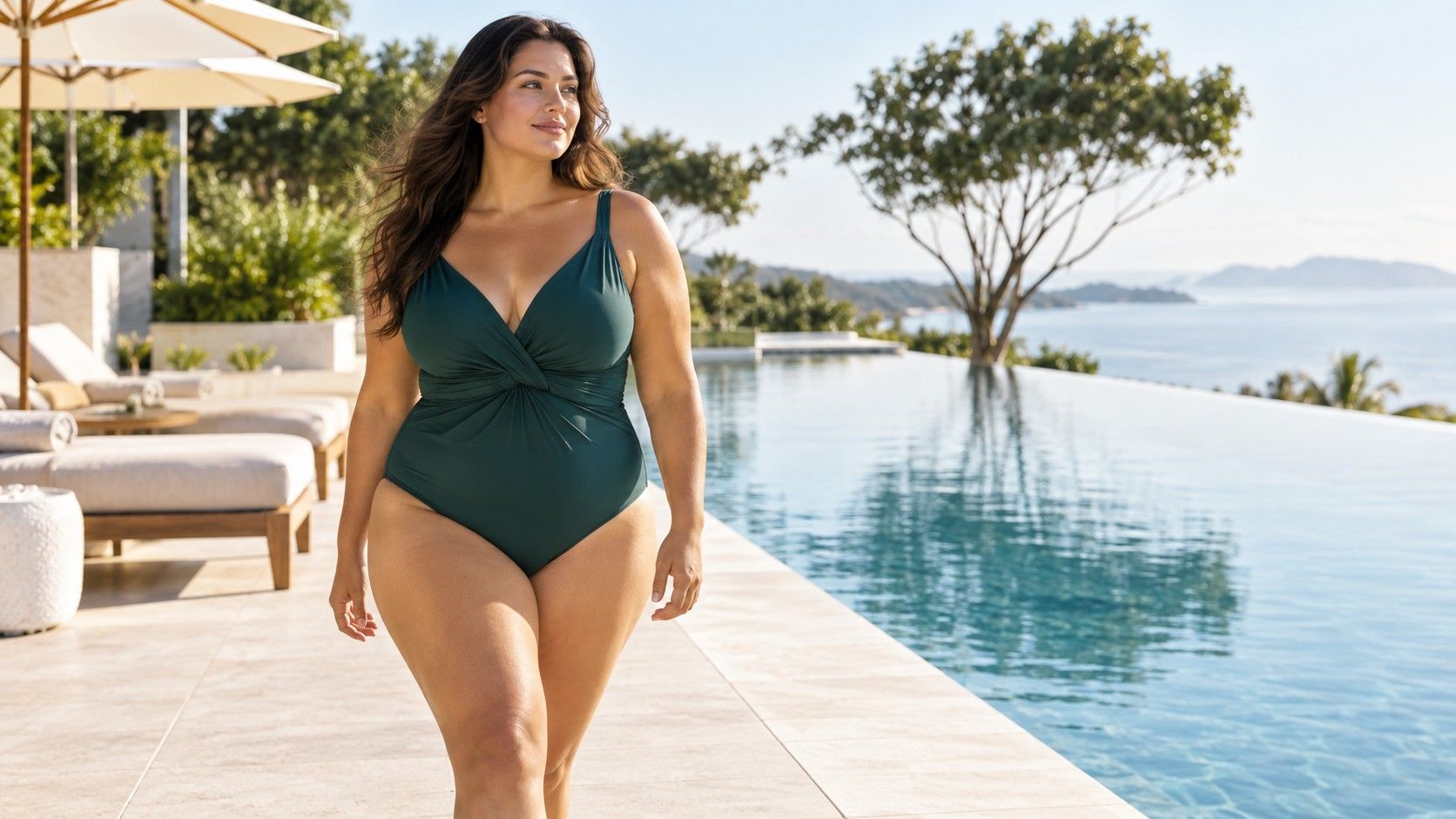
Swimwear is one of the few clothes that has to stay comfortable when it is wet, stretched, sandy, and in motion. That makes fit more useful than the promise of a flattering cut. A swimsuit that supports the areas you want supported, stays in place in water, and lets you move freely will serve you far better than one chosen to correct an imagined problem.
Fit matters more than a flattering label
Terms such as “best swimsuit for body type” can be a useful search shortcut, but they do not describe the things that make a suit wearable. Bust support, torso length, coverage, strap tension, and fabric recovery are measurable. A body-shape label is broad, while two people with similar shoulder and hip proportions may need entirely different cup construction or leg openings.
Choose a one-piece or two-piece by adjustment needs
Start with the activity. Sunbathing, lap swimming, paddleboarding, and playing with children at the beach make different demands. A suit for lying on a towel can have delicate ties and minimal support. A suit for swimming needs straps that do not creep toward the neck, lining that does not go transparent when wet, and an opening at the leg that stays put through a kick. Choose the use first, then decide how much coverage or visual contrast you enjoy.
Check straps, cups, and support before the mirror test
A one-piece can give a continuous line and may feel secure, but it must match the length of your torso. If the shoulder straps pull hard, the leg openings climb, or the suit creates horizontal strain across the stomach, the torso is probably too short even if the width seems correct. A long-torso version, adjustable straps, or a suit with a lower back can provide length without going up a whole size.
A bikini separates top and bottom sizing, which is often its most practical advantage. If your ribcage, bust, waist, and hips do not match one brand’s size chart neatly, buying separate pieces avoids a false compromise. High-waisted bottoms are not required for any particular shape; they simply offer a different waist position and coverage level. A lower-cut bottom can feel freer around the stomach, while a higher waist may stay steadier during swimming.
Tankinis and longline bikini tops sit between the two. They can be useful when you want the convenience of a two-piece with more fabric over the torso. Check that the top does not float upward in water. A loose hem may look relaxed when dry but become distracting as soon as you start swimming.
Straps should hold the suit in place without leaving deep marks after a few minutes. Adjustable straps are valuable because shoulder slope and torso length differ even among people who wear the same size. If a strap is already at its tightest setting in the changing room, it has little room to compensate as the fabric relaxes. Racerback and cross-back styles can distribute tension differently, but they should not make it hard to reach or change clothes.
For bust support, inspect the construction rather than the neckline name. Molded cups give shape but can be awkward if their volume or position does not match you. Shelf bras provide light support; underwires or bra-sized tops can give a more anchored feel. The center front should sit close enough to the body without digging, and the underbust band should stay level when you lift your arms. If the band rides up, the support is coming from the straps instead of the torso.
| Need | Useful feature | Quick check |
|---|---|---|
| More bust support | Firm underband, adjustable straps, structured cups | Raise arms and see whether the band stays level |
| More torso room | Long-torso cut, lower back, adjustable shoulder straps | Sit and check for pulling across the front |
| Secure swimming coverage | Fully lined fabric and stable leg openings | Squat, step up, and twist at the waist |
| Flexible sizing | Separate bikini top and bottom | Fit each piece to its own measurement |
Adjust coverage and leg openings to your comfort
Coverage is not a virtue scale. It is a preference that can change by location, activity, weather, and confidence on a particular day. Try the back coverage while walking, not only facing a mirror. If you keep pulling the fabric down, a wider back or a firmer elastic edge may be more comfortable. If the fabric bunches at the crease of the leg, the opening may be too low or too loose for your movement.
Leg openings affect both feel and proportion. A higher opening exposes more of the side hip and can make a one-piece easier to walk in. A lower opening provides more fabric at the upper thigh and may feel more secure. Neither choice is a rule for a particular body shape. Pay attention to whether the elastic lies flat without cutting in or turning outward; that is the sign of useful fit.
Move before you decide
Use a small movement circuit in the fitting room. Reach overhead, bend to touch your toes, sit, rotate your torso, and take several large steps. If possible, imitate a swim stroke. Notice whether the neckline shifts, the cups move away from the body, or the bottom changes position. A suit that requires a discreet adjustment after every motion will be annoying at the pool, where wet fabric is harder to reset.
Finally, consider fabric recovery. Good swim fabric should return toward its original shape after stretching, not remain baggy at the straps or seat. Rinse a suit after saltwater or chlorine and let it dry away from direct heat; care will not fix a poor fit, but it can keep a good one stable. The most dependable swimwear for body shape is the suit that lets you forget about body shape once you are in the water.
Size charts are a starting point rather than a verdict. Measure around the fullest bust, the narrowest part of the torso, and the fullest hip, then compare each number to the brand chart. If one measurement points to another size, prioritize the area with the least adjustment built into the suit: a non-adjustable one-piece needs torso length, while a bikini can be chosen as separate pieces.